The “art” and the skill of successfully leading projects is often underestimated in any business organisation. The lead trainer has put these syllables together and with a clear purpose based on his profound experience gained through a variety of industries, geographies and functions where he led numerous innovations, market launch, testing, supply chain integration, cost down, technology development and other project types. His organisational coaching and capability in building the team skills have led to development of best Project and Program Management Essentials; the course is broken down to 9 essential modules that any Project/Program Manager needs to know well.
These are the modules making up the training course:
- 2.1.1 Preparation for Project Execution
- 2.1.2 Collaborative Planning
- 2.1.3 Project Execution Model – “Project Engine”
- 2.1.4 Project Milestone Governance
- 2.1.5 Resource Management
- 2.1.6 Project Portfolio Management (Project Office)
- 2.1.7 Project Performance Management
- 2.1.8 Stage Gate vs. Hybrid Agile Project Delivery
- 2.1.9 Project Scalability & Complexity Assessment
Duration
Typical duration of the training is 3 days to cover all 9 modules in sufficient depth to make a practical impact. The training is highly scalable and adaptable to the organisational needs. An accurate estimate of the actual training duration will be available upon an initial consultation with the client. Collaborative planning workshop on a real client project can last between 1-3 days, all subject to complexity of the project, size of the project t team etc. All other execution support is to be discussed and aligned as part of the OPINEX Program support.
Who is it for?
- Project and Program Managers
- Project team members
- Line/Resource Managers
- Project Office Managers
- Anyone else wanting to sharpen project management skills and is participating in projects
Content
- 2.1.1 Preparation for Project Execution stresses the importance of clearly defining project organization (the team) and aligning it to well-defined project targets. It is not just about having a team but structuring it effectively and connecting it to measurable goals. The typical project phases used in project management are described, as defined by the Project Management Institute (PMI). The concept of the “Fact Pack,” a structured document that unifies pre-planning project related knowledge, is introduced.
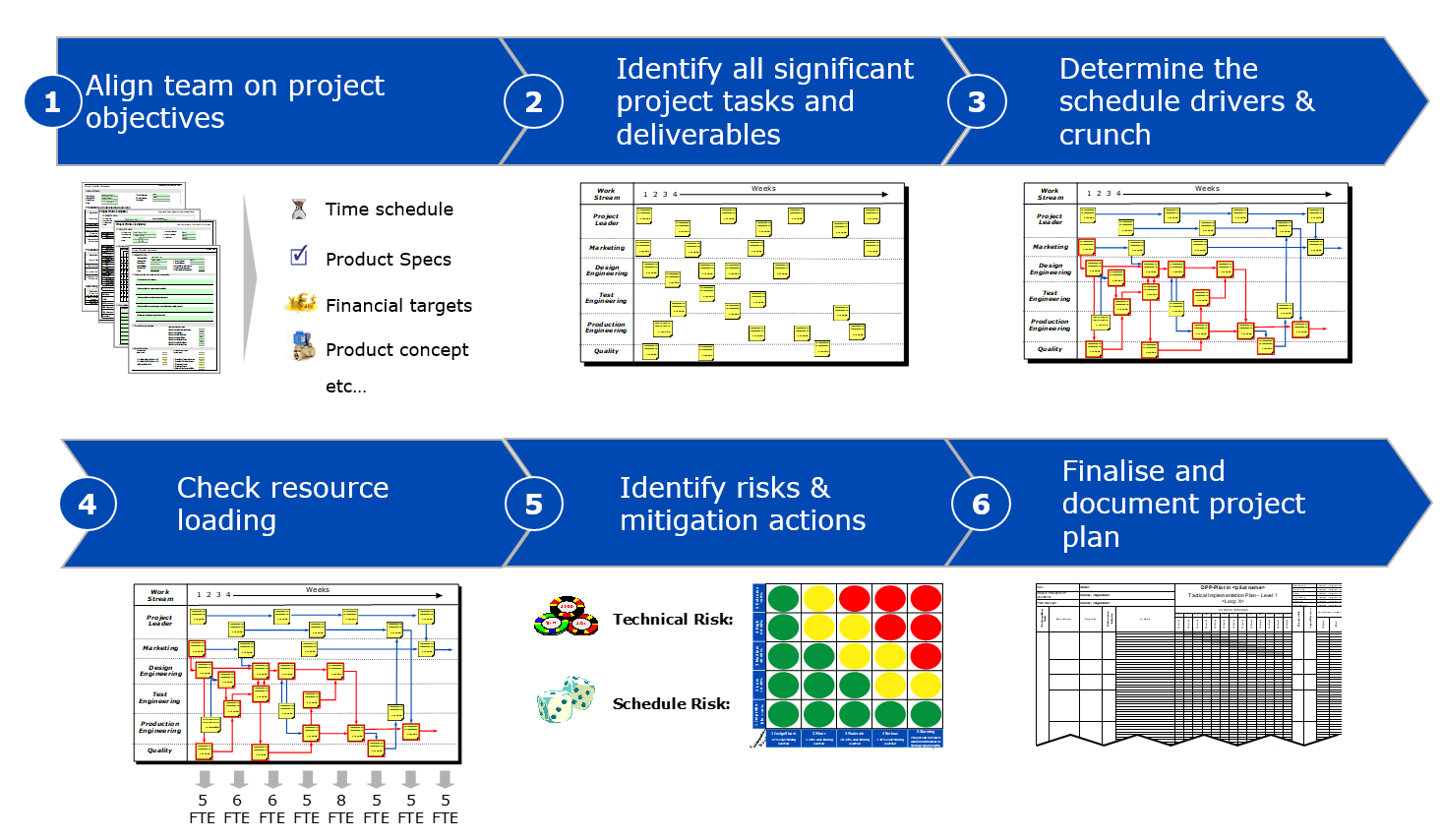
- 2.1.2 Collaborative Planning defines a process for developing the project plan and explains all prerequisites required to have a successful project team’s planning workshop. This enables participants to define the type of the project plan required relative to the project complexity and the team size. It also makes them familiar with the concept of the skeleton vs. detailed plan vs. work breakdown structure (WBS), use of sprints to execute in time-boxed manner, the purpose of the buffer management and how to set the task interdependencies. Collaborative planning assumes a team planning practice of the acquired skills. This can be extended to a proper planning workshop on a real client project and with the real project team.
- 2.1.3 “Project Engine” is a term used to describe a model for executing a project according to the plan. Project Engine has the following key elements: key meetings’ structure & frequency, key documents to run the project and the project board tool as a visual aid for the knowledge sharing. The “Project Engine” is essentially a “PDCA” (plan-do-check-act) structured approach to working towards the project’s objectives. Project risks and tasks management tools are practically demonstrated, and relevant templates are shared for use in real projects.
- 2.1.4 Project Milestone Governance ensures discipline in preparing, executing and documenting the project Milestone (Gate) meetings. It defines the roles and responsibilities of the Management and the Project Team. The Governance enables support and escalation of issues between the Management and the Team ensuring proper communication and dynamics. “RACI” (responsible-accountable-consulted-informed) model is explained as a foundation for understanding various project related roles and responsibilities.
- 2.1.5 Resource Management enables the project to be supported with skilled resources in all project phases. The resource requirements may vary throughout the project, and sometimes unexpected project situations do require additional resources at hand. As there is no magic and no simple prescriptive way to assign resources, this skill largely depends on consolidated empirical knowledge being generated in the organisation. Equally examples of good practice should be always documented. Effective Resource Management relies on having a realistic project plan in place, developed by the project team.
- 2.1.6 Project Portfolio Management (Project Office) defines the effective management tool for managing multiple projects in the organisation. Project execution capacity is always limited and requires a prioritisation and focus on projects with the highest commercial success feasibility. The “Project Office Manager” function is explained, and some useful tools for visualization of the Project Portfolio status reporting are described. Further practical advisory support with the establishment of the Project Office function is possible.
- 2.1.7 Project Performance Management is calibrated and scaled relative to the nature of the projects in the client organisation. Quantification and measurement of success is the key to delivering successful projects. This is often underestimated in many organisations.
- 2.1.8 Stage Gate vs. “Hybrid” Agile Project Delivery explains how agility evolves from typical challenges observed during running projects in a pure Stage Gate mode. “Hybrid” Agile Project Delivery model comprises of the Stage Gate project framework and the Agile/Scrum execution engine blended into “hybrid” project execution model. “Hybrid Agile” can be used to run projects with mixed SW, HW and mechanical content or whenever there is a need to achieve flexibility and performance of the project teams.
- 2.1.9 Project Scalability and Complexity Assessment allow the Project Manager to review the key work streams, identify challenges based on the Project Brief (“Fact Pack”), identify functional activities that should be scaled up or down & document the reasoning before project Kick-off.
Delivery options
- Initial consultation: virtual 2-hour meeting (free of charge)
- Virtual delivery of training modules (6 half-a-day sessions) for all 9 training modules
- Physical on-site delivery over (typically) three full days is a possibility
- Agile, iterative & practical (on-site and virtual) support in preparing for project delivery, developing resource strategy, establishing the Project Office function, project planning, establishment of the execution model, performance management and any other practical support is available upon request as part of OPINEX Program
Objectives
- Understand how to prepare for planning activity and for project execution and utilise the “Fact Pack” to align the team on the common content knowledge relevant for the project
- Gain practical demonstration of the project planning skills required to gain team commitment to deliver the objectives. Share templates for capturing and documenting the plan during and after the planning
- Get introduced to the concept of the “Project Engine,” and practice the use of tools like Risk Management, Monthly Reporting, and Daily Stand up (Project Board) meetings to effectively execute the project daily. Gives both the Project Manager and the team a hands-on, documented best practice execution approach that can be adapted to any project situation
- Learn how to prepare, execute and, document Milestone (Gate) meetings and its outcomes. Drives the understanding and application of the “RACI” model to developing a clear project and organisational responsibility matrix focused on project’ delivery
- Understand effective resource management techniques that are derived from having an aligned and well-documented project plan as a reflection of the team commitment to deliver. Practicalities (templates and their use) of resource planning and monitoring during project execution will be available
- Understanding how to set up the Project Office and optimize the size of the Project Portfolio. Learn how an effective Project Office Manager should perform their function
- Performance Management (for a single or for a portfolio of projects) will be introduced as a set of practical (monitoring, reporting, and escalation) guidelines that can be translated to a practical performance management dashboard led by the Project Office Manager. The benefits of effective data management, supportive of performance management, will be highlighted
- Gain an understanding of how to create an agile project execution mindset as a way forward in improving the delivery of projects. Practical guidelines on how to go about introducing a scalable Hybrid Agile Project execution model will be shared
- Scalability is key to effective management of projects; some practical guidelines will be shared
Outcomes
- Organisation will be well trained in all aspects of Project/Program Management, and will have gained a unique set of practical, complementary skills and documented guidelines to start a- all-new Project Office Organisation or improve the functioning of an existing one
- Execution and governance discipline will be introduced, leading to positive, predictable and measurable project outcomes
- The organization will be given a founding pillar for strengthening its project execution capability